

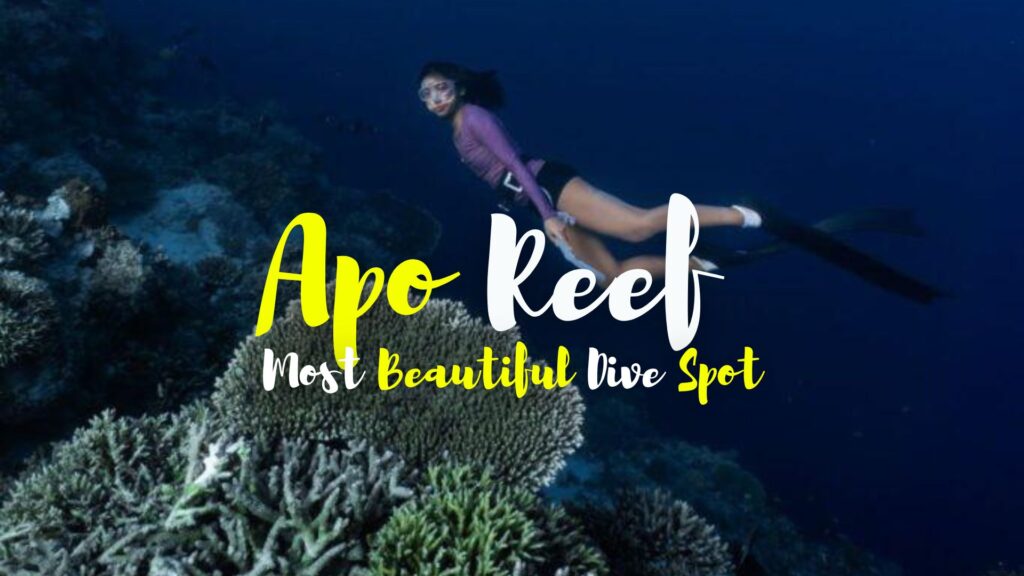
Apo Reef took my breath away.
Seriously.
As a freediver, I’ve been to the best dive sites around the Philippines.
Coron. Camiguin. Bohol. Moal Boal. Dauin.
Yes, they are all lovely.
But nothing could have prepared me for the stunning, surreal beauty of Apo Reef.
Let me tell you this: if you love the ocean and you haven’t been to Apo Reef – YOU HAVE TO GO.
Sure, it’s not an easy trip.
Finding a tour is tough…and there’s always a chance it’ll be canceled due to a sudden storm or not enough “joiners” (meaning there aren’t enough guests to push through with the tour).
But it’s worth it.
If you love adventure and don’t want to miss out on seeing the rare, spectacular, otherworldly splendor of the ocean and underwater life…
…it’s time to plan your trip to Apo Reef. 🌊
In this guide, I’ll tell you everything you need to know to enjoy the Philippines’ largest and most beautiful coral reef.
Apo Reef Fast Facts
📍 Where is Apo Reef? Apo Reef is found in Sablayan, Occidental Mindoro, 512 km (318 mi) from Manila.
⛵ Tour Operator: Explore Occidental Mindoro Travel and Tours
💸 Tour Cost PHP7,000 – PHP9,000 ($115 – $145)
🚐 Pick-Up Point: Abra de Ilog, Occidental Mindoro
✈️ Nearest Airport: NAIA (Manila) or San Jose Airport (Occidental Mindoro)
💳 ATMs: None (available in Sablayan town only)
📶 Mobile Signal: None
💬 Languages: Filipino, English
⛺ Accommodation: Camping only
🛡️ Safe for foreigners? Yes! Apo Reef is considered very safe for foreign visitors when visiting with a licensed tour operator.
☀️ Best time to visit: Dry season (November–May); peak season is January–May.
4 Reasons You Should Visit Apo Reef (Fun Facts)
First things first!
WHY should you visit Apo Reef?
Because if you only have a couple of weeks in the Philippines, why do you have to take the long journey here, when other areas are so much more accessible?
Well…
Here are 4 great reasons to visit!
Reason #1: Apo Reef Is the Second-Largest Reef System in the World (Next Only to Australia’s Great Barrier Reef!)
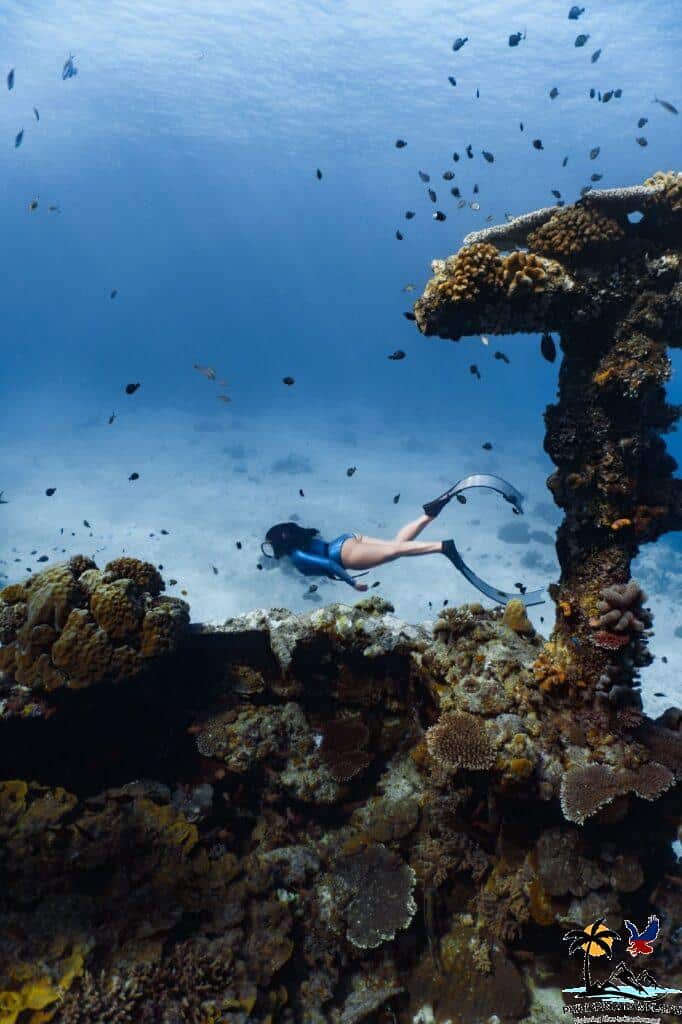
Apo Reef is 34 square kilometers wide.
It is an atoll-like reef, meaning it forms a wide oval underwater.
Of this 34 square kilometers, only about 0.3 square kilometers lie above the water in 3 tiny islands (Apo Island, Apo Menor, and Cayos del Bajo).
Apo Island, the biggest of the 3 islands (around 0.2 square kilometers wide) contains a sandy strip of beach, a mangrove forest, and a lagoon. Visitors to the reef can sleep in tents here.
The 2 other islands are only a collection of rocks and brush.
So yes – the other 33+ square kilometers of Apo Reef lies beneath the surface.
Apo Reef is second in size only to the famous Great Barrier Reef of Australia.
When you visit, you’ll only see a few small jutting islands.
But they’re only the tip of a huge, spectacular, unique iceberg of thriving, colorful life.
Reason #2: Apo Island Is Uninhabited (By Humans)
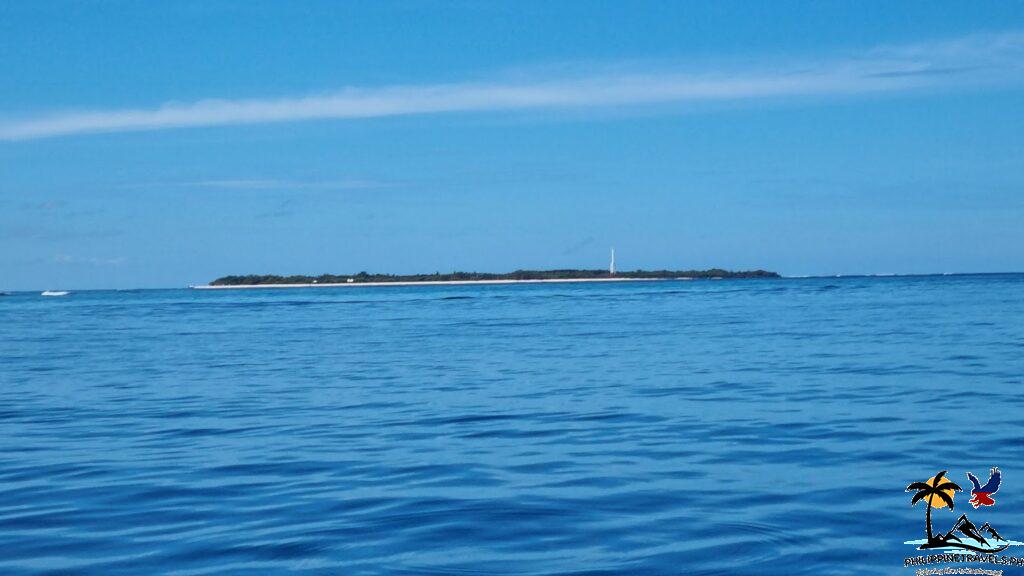
Travel anywhere in the Philippines, and you’re bound to bump into a family or two.
Even in the most remote mountainous slopes, you’ll see a hut draping itself over a steep rocky cliff.
Not Apo Reef.
No humans live there, aside from the park rangers who take care of the sanctuary.
Reason #3: Apo Reef Is Home to Hundreds of Species of Corals and Marine Life
In 1996, former president Fidel Ramos declared Apo Reef a protected natural park.
This has kept it safe from threats like overfishing and pollution.
Today, it is a brilliant, thriving ecosystem.
It is home to over 500 species of fish and 400 species of coral.
Yup!
Visiting Apo Reef means not only gliding between huge table corals and underwater plant life of all colors…
…but also the chance to see dolphins, hammerhead sharks, thresher sharks, barracuda, manta rays, eagle rays, Napoleon wrasses, sea turtles, fish of every color and shape and size, and much more!
Reason #4: Apo Reef Isn’t Your Next-Door Neighbor
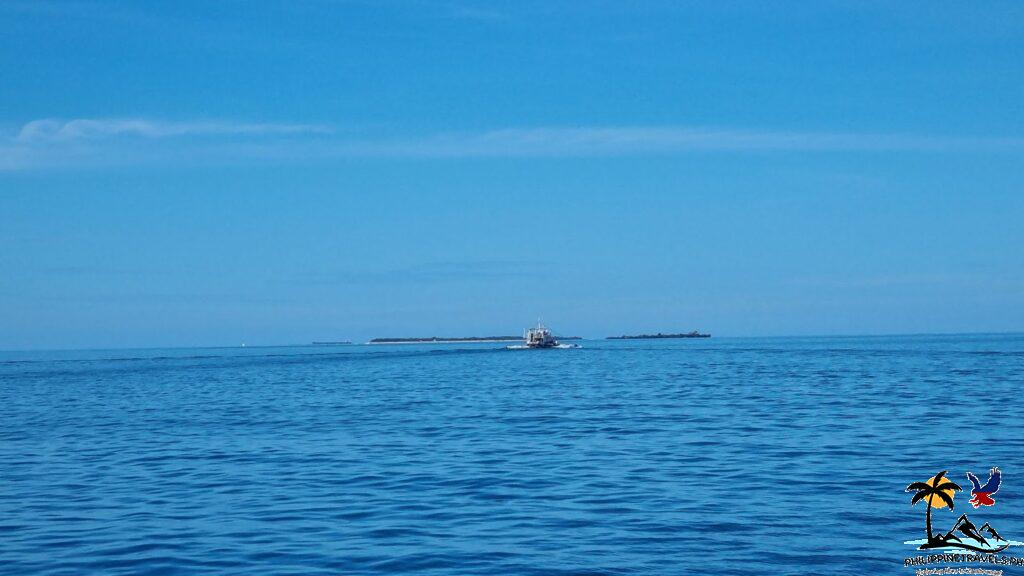
Apo Reef is far away.
And when I say far, I mean it.
I’ll get more into this later in the blog, but for now, here’s a fun fact:
Apo Reef is 30 kilometers from Sablayan Port (a small, fishing town in Occidental Mindoro).
The only way to get there is by a simple outrigger boat, which doesn’t go very fast.
(Look how exhausted I am here – haha.)
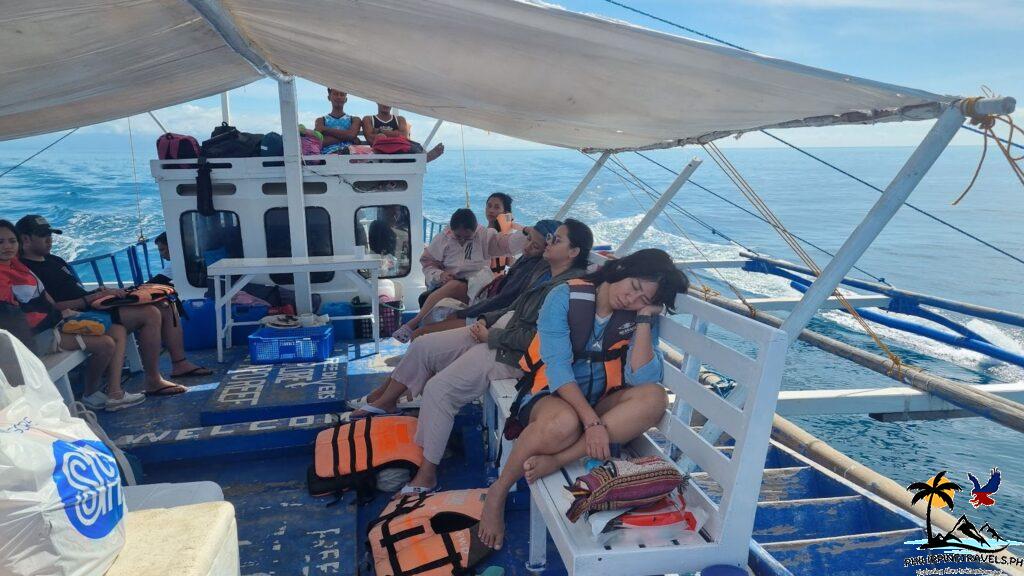
So no, it’s not an easy day trip to a next-door-neighbor island.
The boat ride takes 3 or more hours from Sablayan.
But, in a way, that’s what makes Apo Reef special.
It’s not an easy-to-get-to tourist destination.
It’s a far-off island that, once you get to it, is SUPER worth it.
So… are you convinced?
If so, let me show you how to get there!
P.S. Not sure how to fit 3 days in Apo Reef into your Philippines itinerary? I can help you plan your trip!
How to Get to Apo Reef (It’s Not Easy, But It’s Worth It!)
Ok, so here’s the hard part: getting to the marine park.
Apo Reef is isolated, lying 30 kilometers from the nearest landmass.
Plus, Sablayan (where the boats to Apo Island start) is a small town 100+ kilometers from Abra de Ilog (one of the main seaports in Mindoro Island), where you land from the Batangas Ferry.
I know, I know!
It’s confusing.
So let me break it down for you in a few steps.
Step 0: Book a Tour!
There are NO walk-ins to Apo Reef.
You can’t just show up at the port and ask a boatman to take you here.
Everything here is well organized, and you’ll want to book at least a week in advance.
I joined a tour through my freediver friend Michael, while my brother joined a tour with Explore Occidental Mindoro Travel (and it cost him PHP6,850/head ($111)).
I’ll talk more about who to contact to book a tour below.
But once you’ve booked a tour, here’s how to get to the island!
Step 1: Go to Batangas Port

Here are 2 ways to get there:
- Bus from Manila. You can take a bus from SM Megamall in Mandaluyong, or the PITX terminal in Paranaque (book online here). It is around 70 kilometers from Metro Manila to Batangas, so the trip takes roughly 2 hours. Fare is PHP300 ($5) per person. No need to book in advance, as buses for Batangas City leave every hour. Tell the conductor you’re disembarking in Batangas Port, not Batangas Terminal.
Honestly, I was taken off guard with Batangas Port.
I expected it to be just like any other port, with a few food stalls and seats for waiting.
Instead, it was better than many airports I’ve seen.

It has a food court, coffee shops, popular vendors like Mister Donut and Subway…even a mini grocery store!
Plus, this airport-like lounge.

Ok, enough about how fun it is to hang out in Batangas Port (haha).
Step 2: Take a Ferry to Abra de Ilog
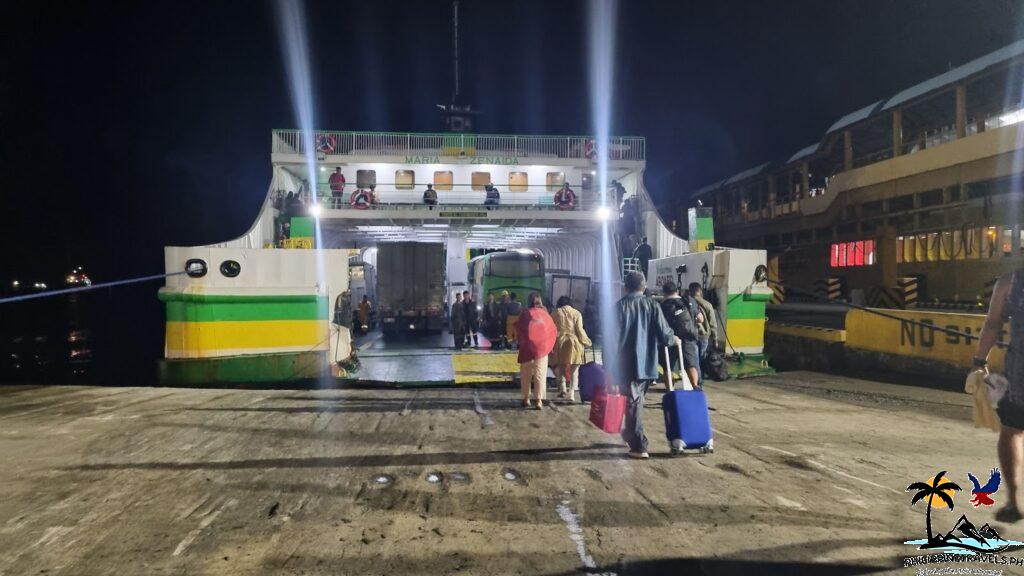
Once in Batangas Port, buy a ticket for Abra de Ilog.
There’s no online booking for this, but the boats here rarely get full.
Montenegro shipping lines is a good option – they have trips to Abra de Ilog roughly every 3-4 hours.
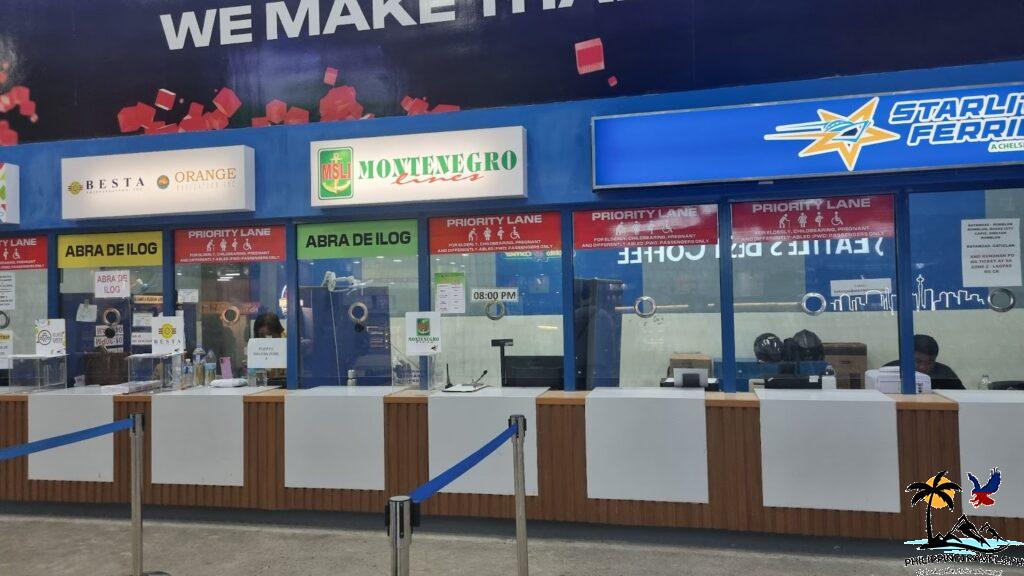
Price for adults is PHP650 ($11) per head. There are discounts for senior citizens and students.
We took the 11:30 pm ferry to Abra de Ilog.
Ok, so the boat broke down and we had to wait 2 hours to get on the boat.
The trip took 2 hours and 30 minutes, so we arrived in Abra de Ilog at 4am.
Did I mention this trip is a bit rough?
Also, look how quiet it is.
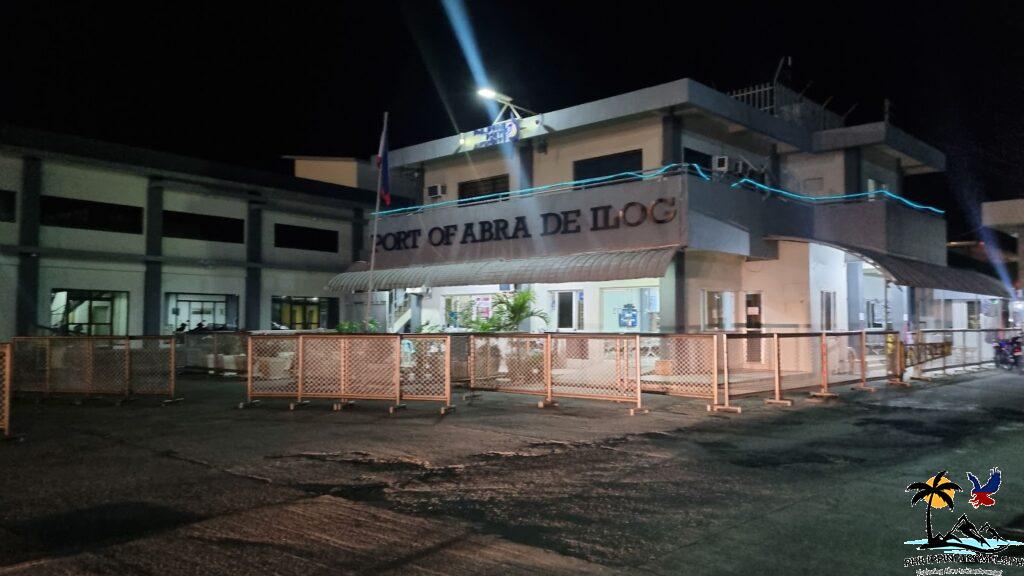
We had to walk across a large slab of pier beside the black sea – the wind was cold and cutting and the vibe was a bit eerie.
Anyway, on to the next step:
Step 3: Ride a Van to Sablayan Port
This is where most tour organizers will handle things for you. They usually have a van service from Abra de Ilog Port to Sablayan.
But if you’re coming DIY, there are van (v-hire) services and buses that take travelers from Abra de Ilog Port to Sablayan. Most of these are going all the way to San Jose, so just tell the driver you’re getting off in Sablayan.
If you don’t mind renting an entire van, it’ll cost you about PHP2,000 ($32.50) per way and can seat 10-12 people. The trip takes roughly 2 hours at breakneck speed. (Maybe 3 hours at a slower pace.)
But again, we didn’t have to worry about this.
The van trip was part of our tour package, so all we had to do when we got down from the ferry was hop into the van and try to fall asleep.
And yes, get really dizzy and vomit too. (Me)

Note: You can also take a taxi from Abra de Ilog port to Sablayan port. This will cost you PHP1,500-2,000 ($25-$32.50) one way.
Step 4: Take a Boat to Apo Reef
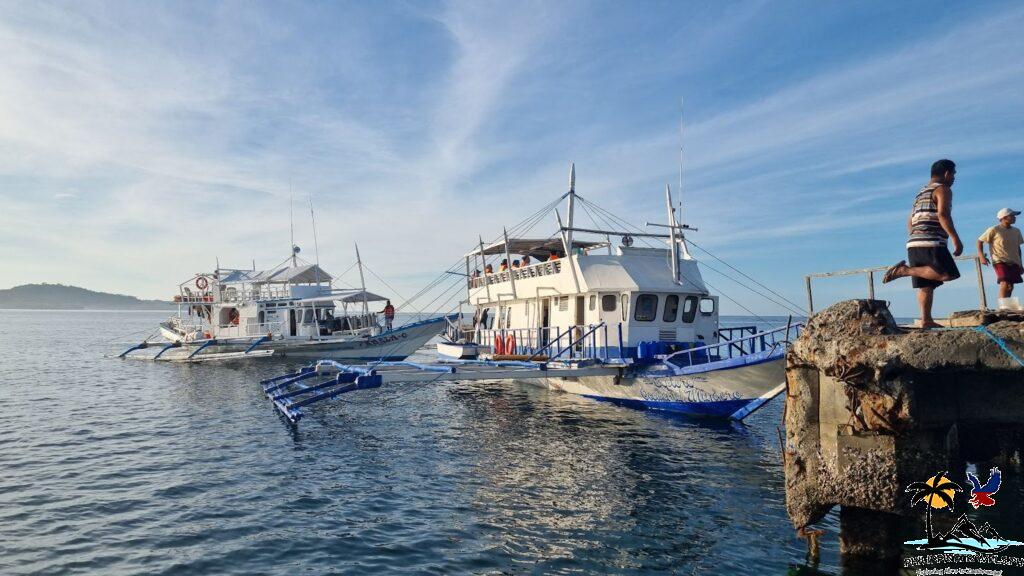
Finally!
You’ve arrived in Sablayan Port after a whole night of traveling.
But your journey isn’t over yet.
The next part is to take a boat to Apo Reef Natural Park.
As I said, it’s 30 kilometers away and these outrigger boats are slow.
So expect to spend another 3-4 hours traveling.
Note: There are no dedicated boat routes to Apo Reef. Boats are hired as part of tour packages – the only way, for now, to get to the marine park.
And…congratulations!
You’ve finally arrived in Apo Reef!
Sure, you’re exhausted and sleepless and a little dizzy from the bus, ferry, van, and boat.
But hey!
You’re standing in one of the most beautiful, pristine, untouched places in the world.
100% worth it, if you ask me.
So for your reference, here’s a summary of the whole trip (the timeline is based on our experience).
| Time | Travel |
| 4:00 pm-6:00 pm | Travel by Bus from Manila to Batangas Port |
| 1:30 am-4 am (delayed from 11:30 pm) | Travel by Ferry to Abra de Ilog Port |
| 4:30-7:00 am | Travel by Van to Sablayan Port |
| 7:30 am-11:00 am | Travel by Boat to Apo Reef Natural Park |
It sounds crazy, but really, it’s not as bad as you think.
I fell asleep on the ferry to Abra de Ilog, and again on the boat to Apo Reef. (I’m not the type who can fall asleep anywhere, but you know, exhaustion.)
And the moment I jumped off that boat into the cold, crystal-clear water surrounding the island, I felt brought back to life in a second.
Remember: “Nothing of worth comes easy.”
Enjoy!!
Apo Reef Tour Operators (Who to Contact)
For now, you can’t visit Apo Reef Natural Park without a guided tour.
The place is a natural marine sanctuary, overseen strictly by park rangers.
The only way you can get there is through booking a tour (scuba diving, freediving, or a plain “joiners” tour).
Also, there’s no online booking for Apo Reef for now. So you’ll need to contact someone and book through them.
Here are some people you can contact for tours!
1. Michael Morales – Best For Deeper Freedivers

If you’re an experienced freediver, you’ll probably love Michael’s tour.
This is because, unlike some other tours (where guides can only dive 10meters, and only stay down for about a minute, Michael is a Molchanovs-certified freediving instructor, can dive up to 60meters, and can stay down for as long as it takes to get you beautiful shots)
Michael is also my friend, fellow athlete, and a great freediving instructor.
He owns a tour agency that organizes fun adventures to places like Siargao, Coron…and yes!
Apo Reef.
Yes, the tour we went on was one of his.
And it was super worth it!
The food was amazing. Think fresh crabs in chili garlic sauce, butter shrimp, crispy fried chicken, steaming pochero (beef bone soup, or “bulalo” if you’re Tagalog), juicy roasted milk fish…and more.
There were vegetarian options too, like tofu with noodles and ampalaya (bitter melon) salad.
Fruits were served with every meal – yup, from breakfast to dinner we had sweet golden mangoes, juicy watermelon, and ripe bananas for dessert.
There was also free-flowing coffee at all times of the day, plus unique snacks like ube cheese buchi (sesame balls) and peach mango turon (banana spring roll, famous dessert here).
There was always more than enough food for everyone.
Those who had allergies simply told Michael and a whole different menu was prepared for them.
Now, the cost.
We were 15 people on the tour, and it cost PHP7,999 ($130) per head. This included all transportation costs (except the bus from Manila and ferry from Batangas) park fees, and food.
Note: Tours don’t always cost the same. The more people join, the cheaper it can be. Expect costs to range from PHP7,000-PHP9,000 ($115 – $145) per person.
Here’s our itinerary.
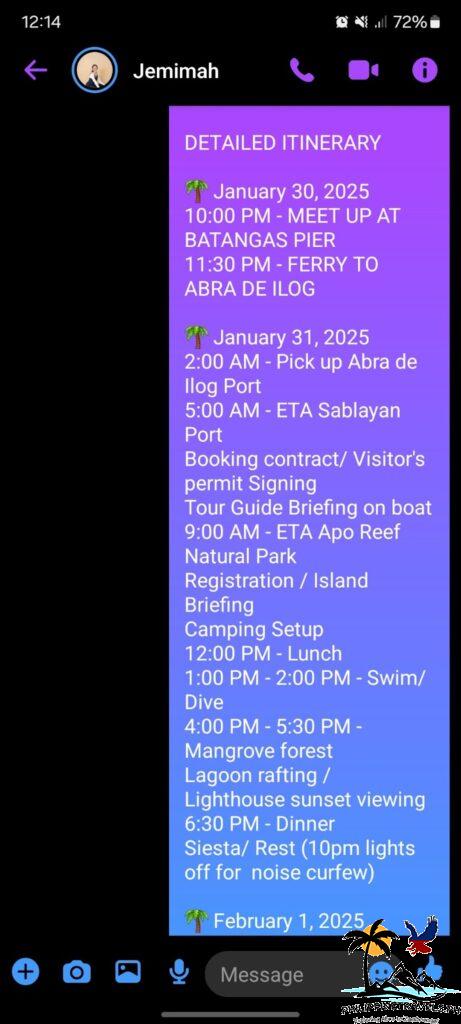
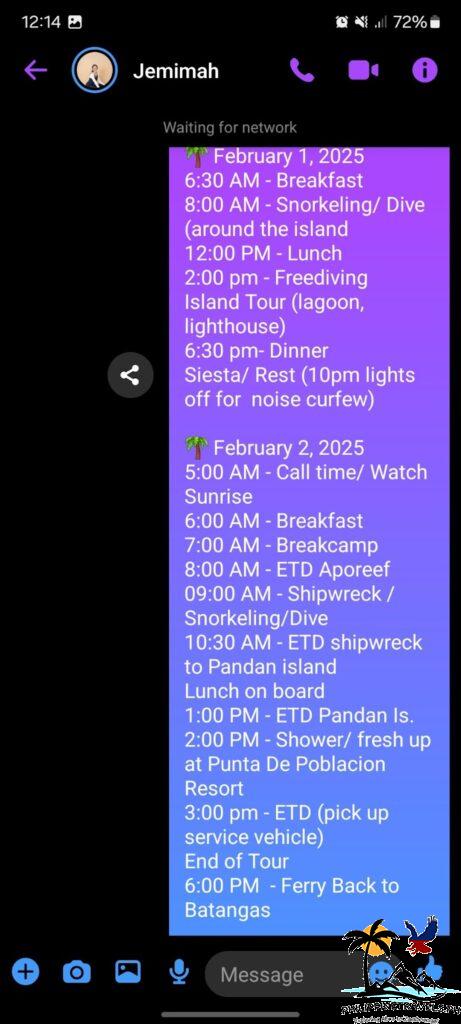
One more thing.
You can’t wake up one morning and decide you’re going to Apo Reef.
Tours there are scheduled well in advance.
My suggestion: contact Michael and ask him when his next Apo Reef tour is.
Because, trust me, this is a once-in-a-lifetime experience and worth planning a whole trip around.
2. Gabriele Inciong – Underwater Photographer

Gab took all the underwater photos in this blog.
He’s an underwater photographer who takes stunning shots of freedivers in beautiful marine settings.
So if you want an amazing shot like this…
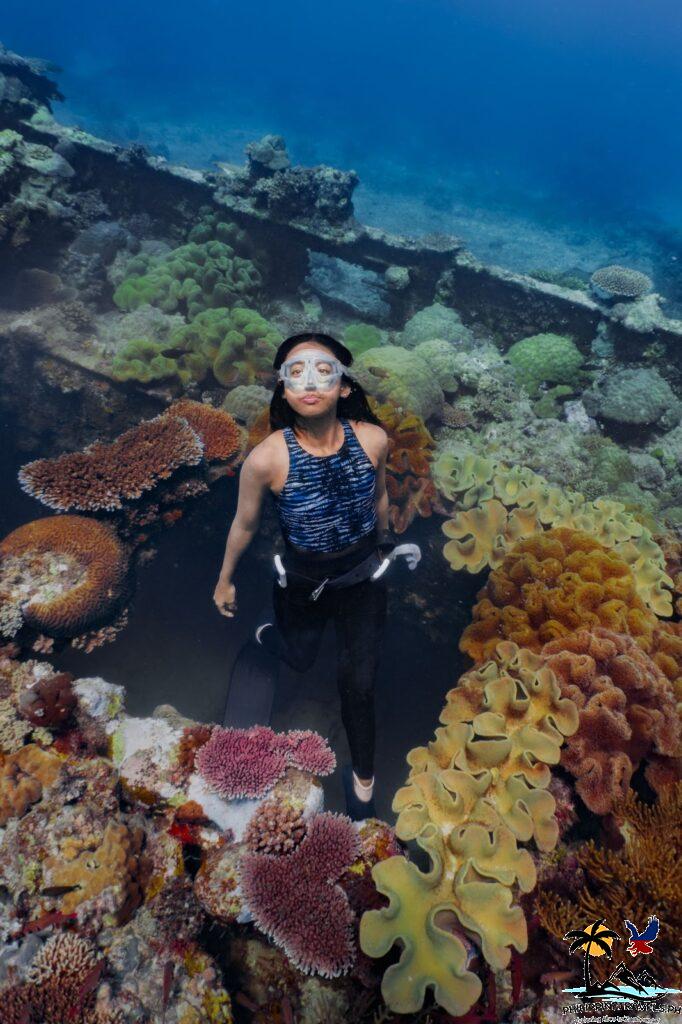
…or this…
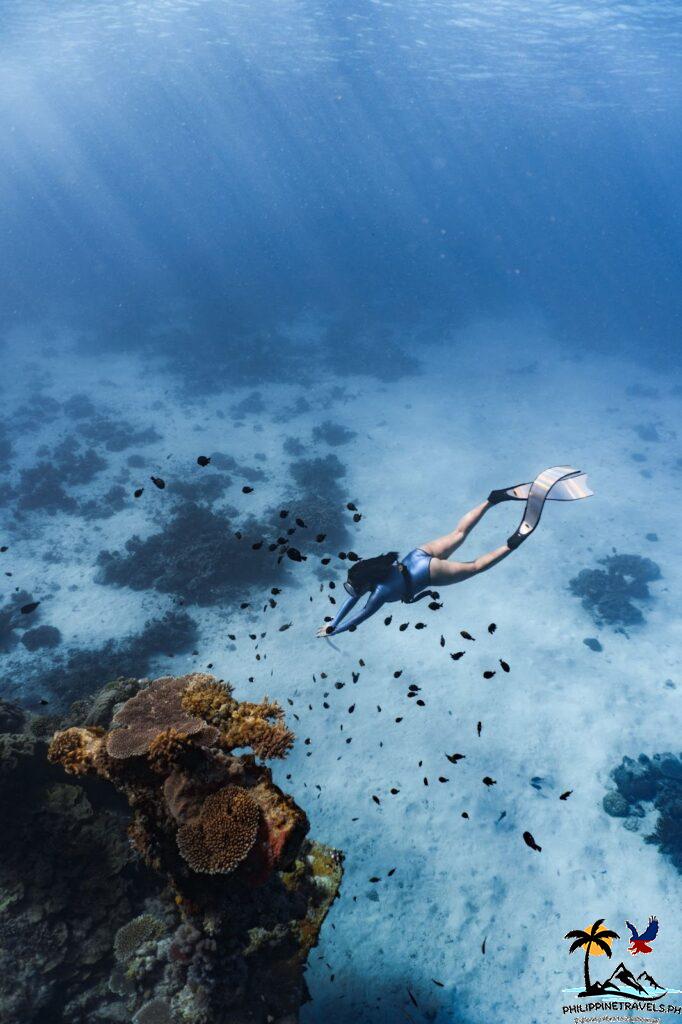
…definitely send him a message.
He also does shoots in other islands, so if you’re interested, contact him here to book a session.
3. Explore Occidental Mindoro Travel and Tours – Most Tour Schedules
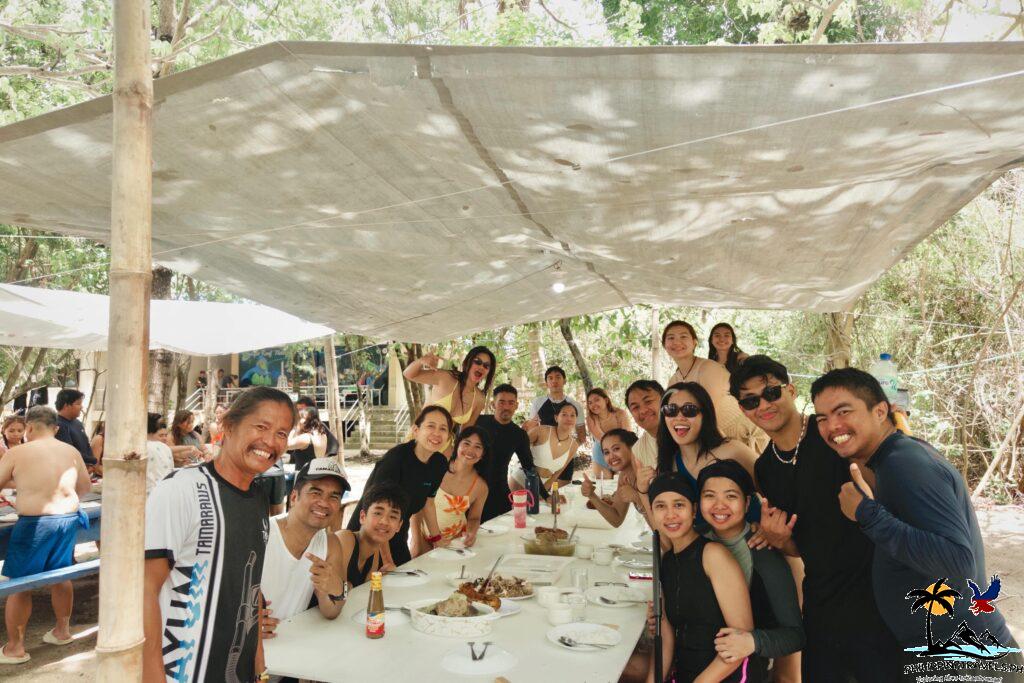
This is the tour that my brother (Manoling) booked.
They’re one of only 3 tour organizers based in Sablayan, and they have the most frequent tours to the island.
So if Michael doesn’t have a tour on your preferred dates, you should definitely contact these guys.
Explore Occidental Mindoro also has a freediving tour guide (Kuya Jun). However, with so many joiners, he can get very busy taking people’s photos (and you’ll have to wait, or ask another joiner to take your photos instead).
These guys also offer private tours, and the lowest prices (since they’re based in Sablayan). My brother only paid PHP6,850 ($111), and got essentially the same tour that I did (minus the expert freediver guide).
So shoot them a message on their Facebook page here!
(Note: the other organizers based in Sablayan are Lagaw Mindoro and Vakaz Travel and Tours. Look them up on Facebook to see their schedules
4. Organizers from Coron, Puerto Galera, or San Jose
If you’re in Coron, look up Pala-One Freediving. They have freediving packages that head to Apo Reef (and some Coron spots too).
If you’re in Puerto Galera, check out MindoroAdvenTOURS for schedules.
Finally, if you’re flying into San Jose airport (or taking a boat from Coron here), check out Mangyan Outdoor Travel and Tours; they also have packages to Apo Reef.
All in all, there are plenty of tour organizers that come here.
The only trick is finding these people and timing your trip to their schedules.
But the best place to look is on Facebook. So type in “Apo Reef joiner tour” and search away!
Apo Reef Dive Spots: 3 Spectacular Dive Sites for the Human Mermaid (Or Merman)
Apo Reef is HUGE.
It would take days to spend time in all its fascinating corners and secret spots.
I mean, everywhere you go within its 34 square kilometers is a feast for everyone who loves the breathtaking underwater world.
But if you’re in Apo Reef for only a few days, make sure you don’t miss these 4 spots.
1. Apo Reef Dive Spot #1: Apo Island Coral Gardens
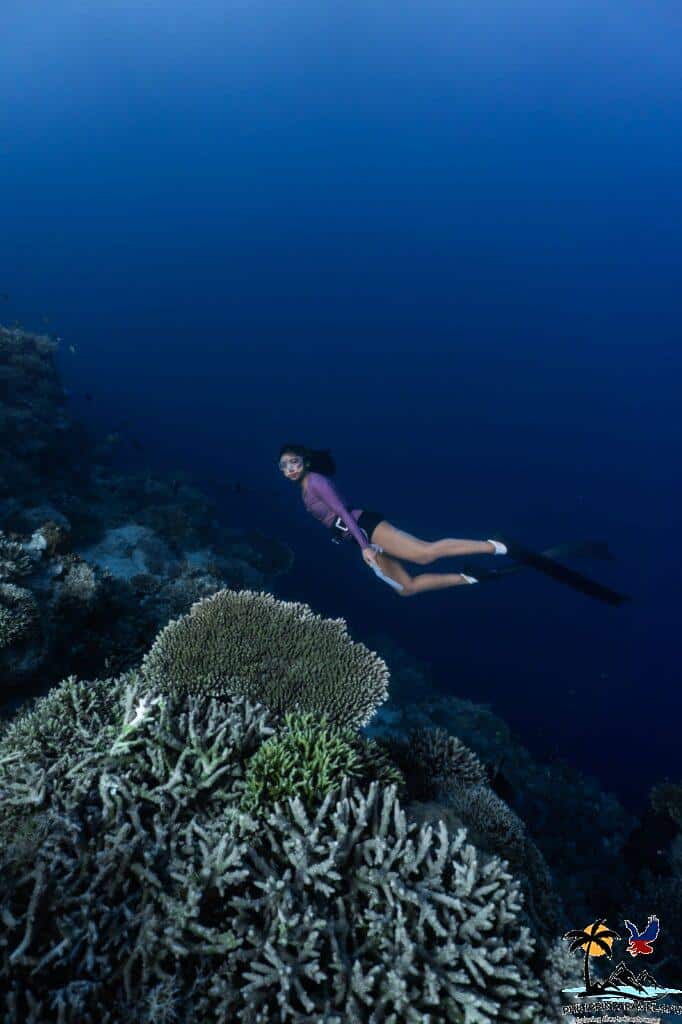
Apo Reef’s main island (Apo Island) is surrounded by rich, thriving, colorful underwater life.
Go anywhere on the edges of the island, swim a few meters out, and you’ll be met with layers of table corals that look like intricate buildings, rust-red and mustard-yellow soft corals, and mounds of branching corals like mini trees.
Between these corals swim fish of all colors and sizes – orange, jet black, electric blue, lemon.
You’ll get to see huge sea turtles, a battery of barracuda, and if you’re lucky, a shark or eagle ray gliding into the deep.
It’s a sight to take your breath away.
There’s even this eerie, sandy spot that looks like the moon’s surface.
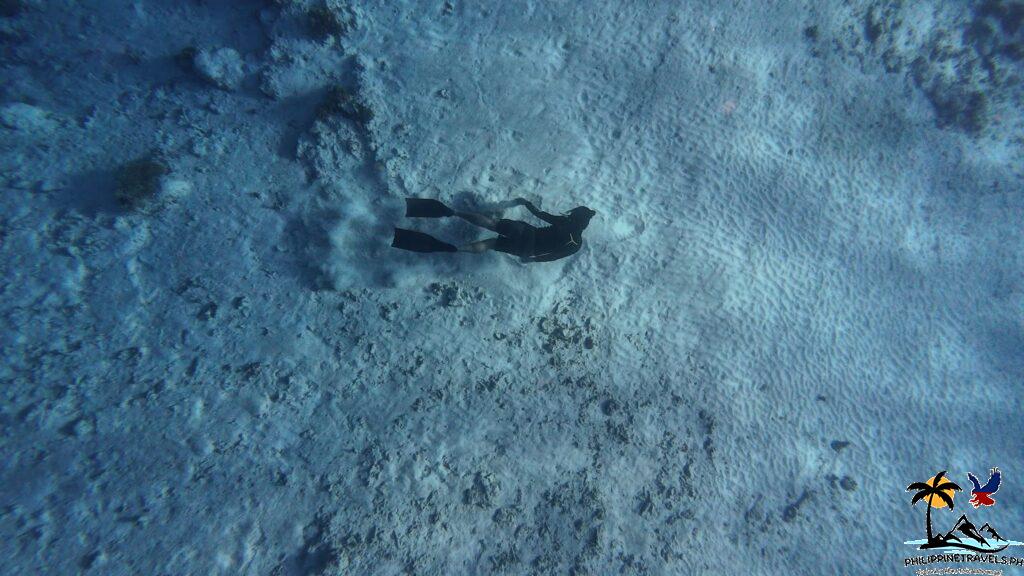
Honestly, there’s just so much to see around the island.
Even if you don’t venture out to the deeper parts of the reef, you’ll already be blown away by so much beauty.
And since the coral gardens are at relatively shallow depths (3-7 meters) anyone can enjoy their splendor…even snorkelers!
2. Apo Reef Dive Spot #2: Shipwreck
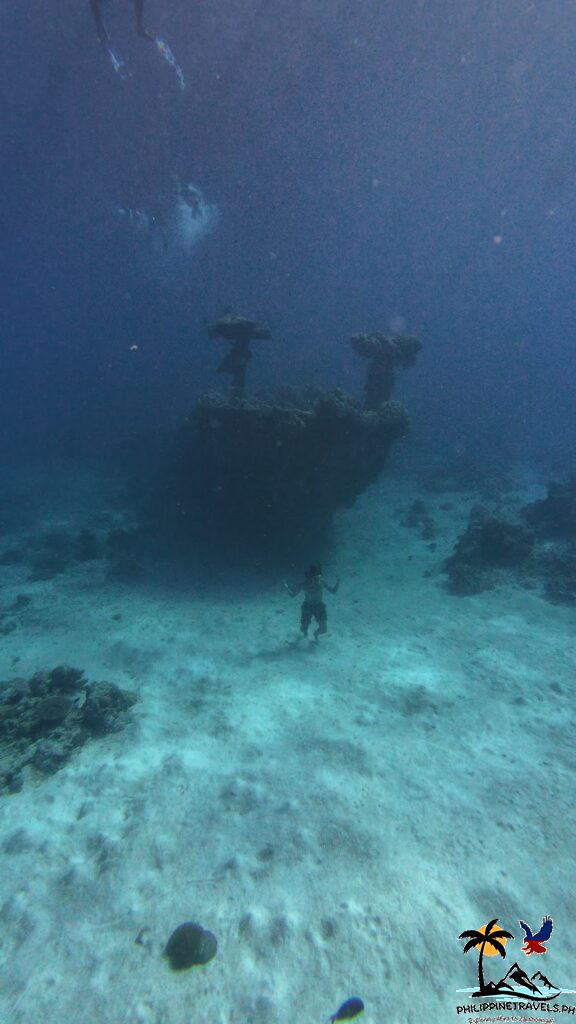
There’s nothing as haunting and exciting as swimming underwater and entering a shipwreck.
And if you thought Apo Reef is all coral gardens…think again!
About 30 minutes away (by boat) from Apo Island, nesting in the deep around 7-10 meters (depending on the tide) is a sunken ship.
The deck is encrusted with multicolored corals…
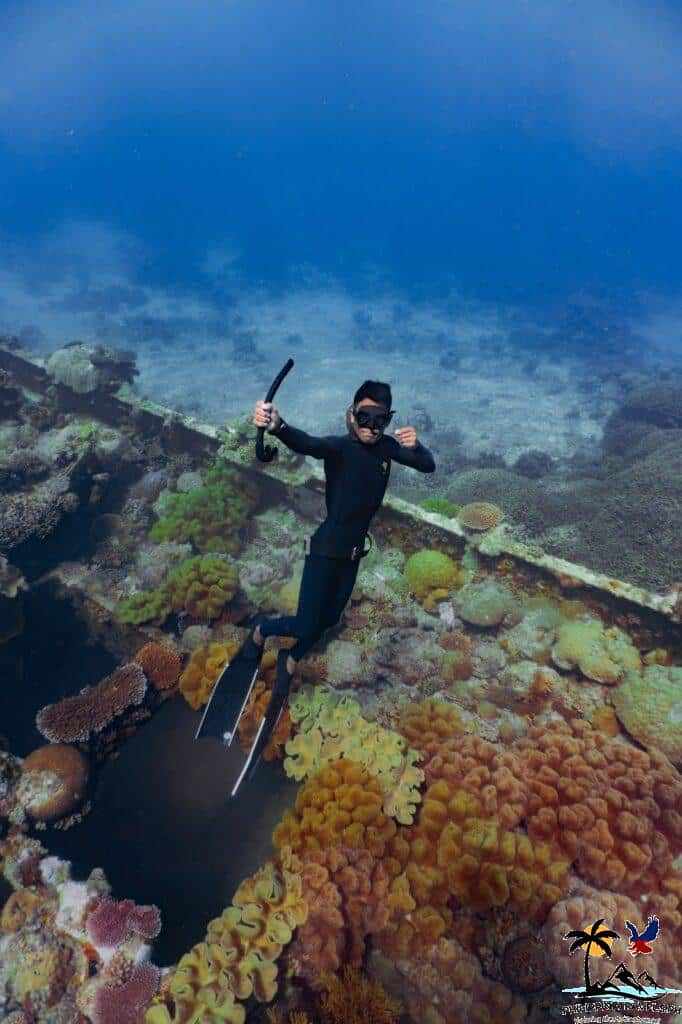
…and if you’re brave enough, you can even enter the ship and imagine you’re Ariel searching for sunken treasure.
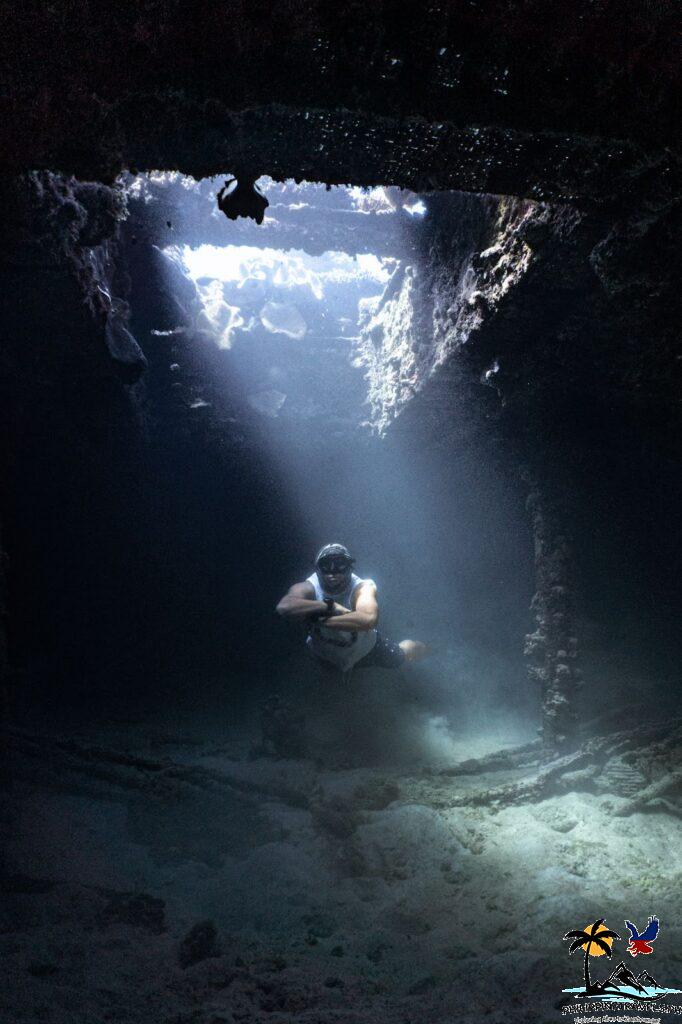
3. Apo Reef Dive Spot #3: Shark Airport
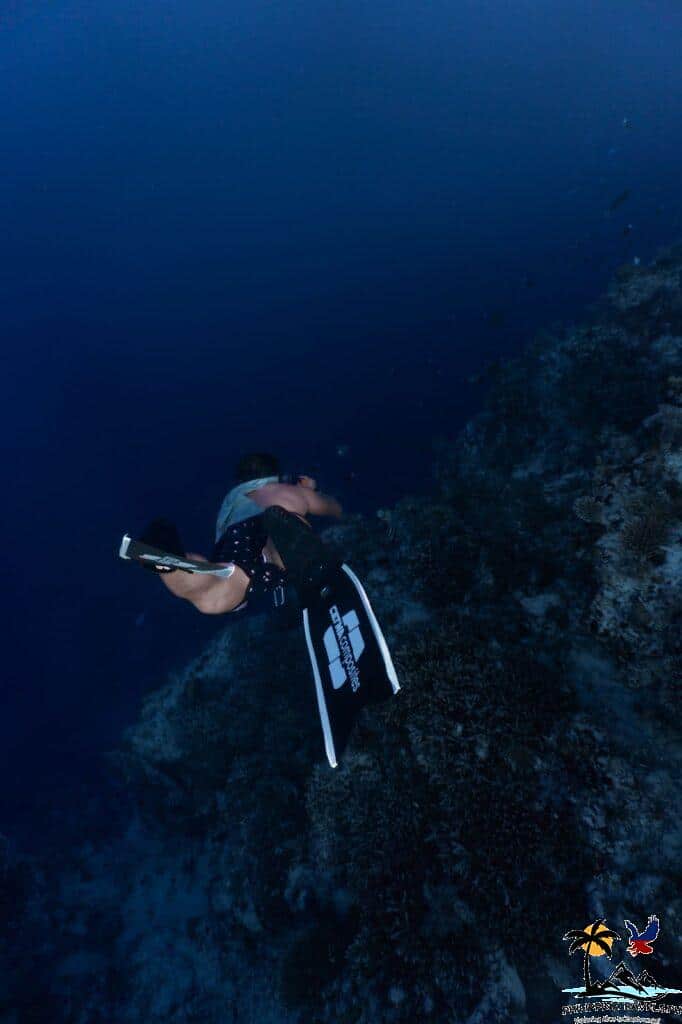
Shark Airport is located around 30 minutes by boat from Apo Island.
It’s next to the other small island, Apo Menor, which is an outcropping of sharp rocks and brush.
This is where sharks (black tip, white tip, thresher) like to sleep.
Unfortunately, you won’t always get to see the sharks.
They don’t have a telephone, and you never know when they’re going to be home!
Also, this spot is for more experienced divers, as you’ll need to dive 20 meters or more to land at their airport.
What to do in Apo Reef for the Non-Diver
Yes, the main activity in Apo Reef is diving.
But if you’re not a diver, that doesn’t mean you should cross it out of your bucket list.
Here are 6 things a non-diver can do there.
1. Go Snorkeling
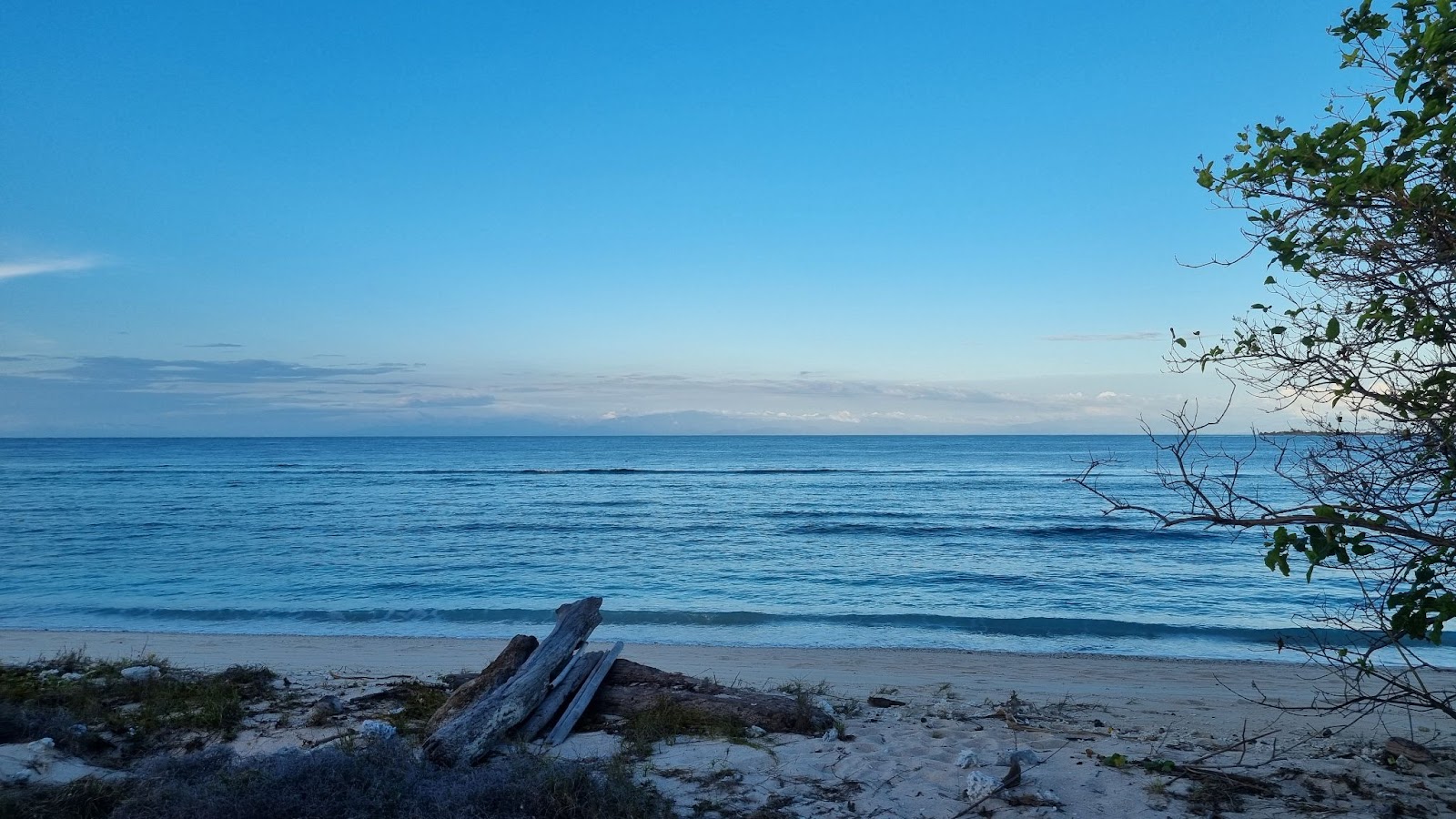
You don’t have to be a deep diver to enjoy Apo Reef.
A lot of the coral gardens are only 3-5 meters deep, and they’re VERY close to shore. So you can enjoy their beauty and color right from the surface.
The water is crystal clear and refreshingly cool, and being in it is a lovely way to spend the day.
2. Relax and Unwind in the Healing Silence of Nature
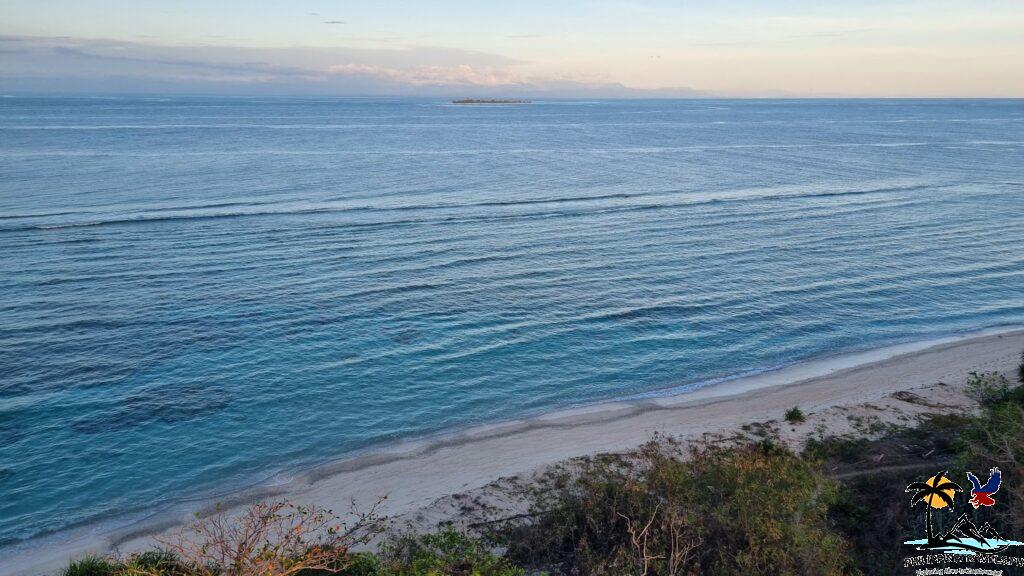
There’s no electricity, cellular data, or fresh running water in Apo Island.
Which means it’s the perfect place to get away, unwind, and detoxify from the noise and stress of life.
Everywhere on the beach, there are benches, swings, huts, and little stools and tables made of wood.
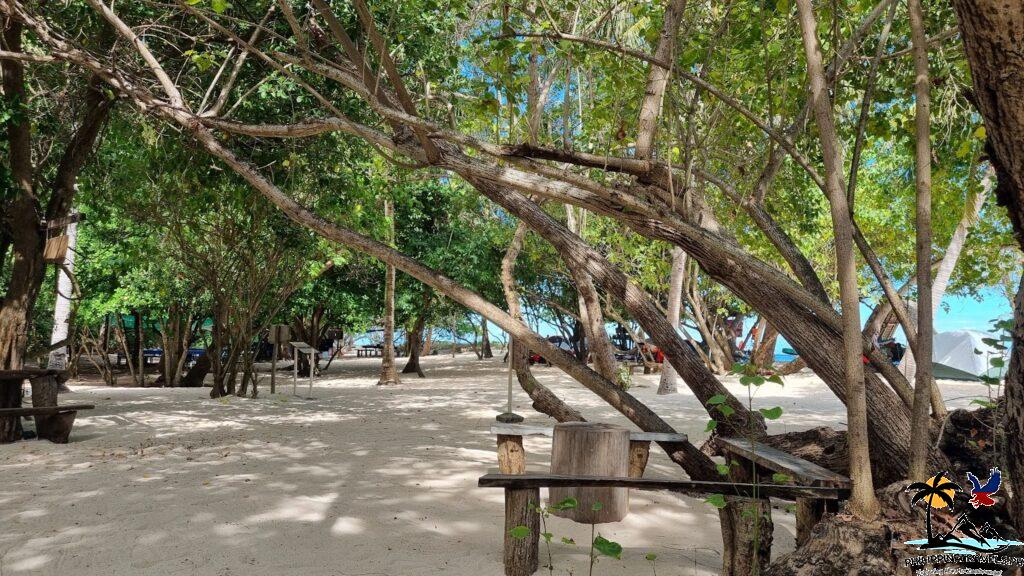
You can have a meal at one of the rustic tables, or swing yourself to sleep on one of these…
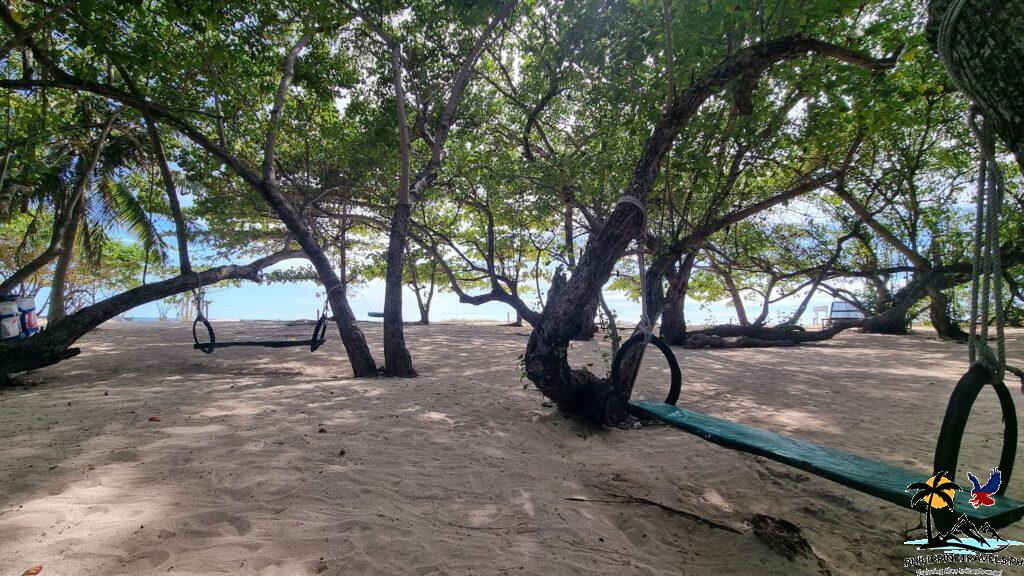
I mean, look at me chilling out with some coffee and a book…
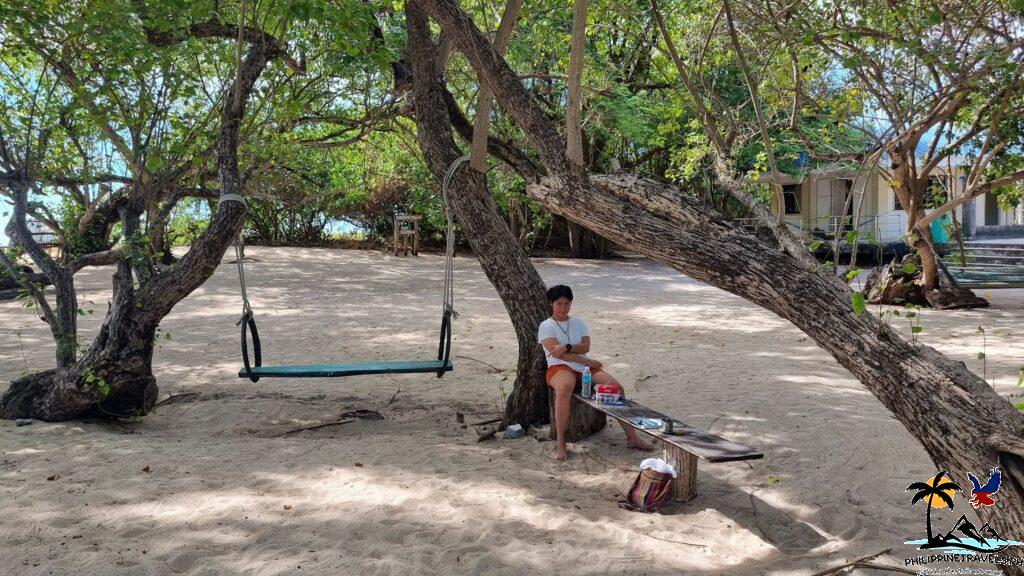
…and journaling while watching the sea.
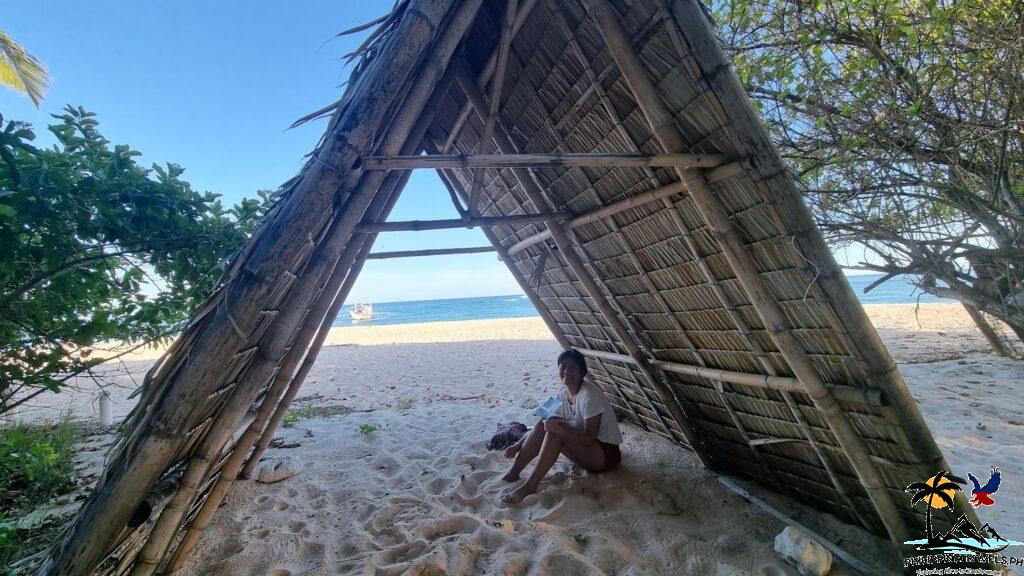
I swear, I could spend a whole month there, listening to the ocean waves roll onto the sand.
If you do nothing else on Apo Reef, make sure to spend some quality time in the silence of nature.
You’ll come away feeling refreshed, revitalized, and calmer than you’ve ever been in maybe forever.
3. Climb the Lighthouse
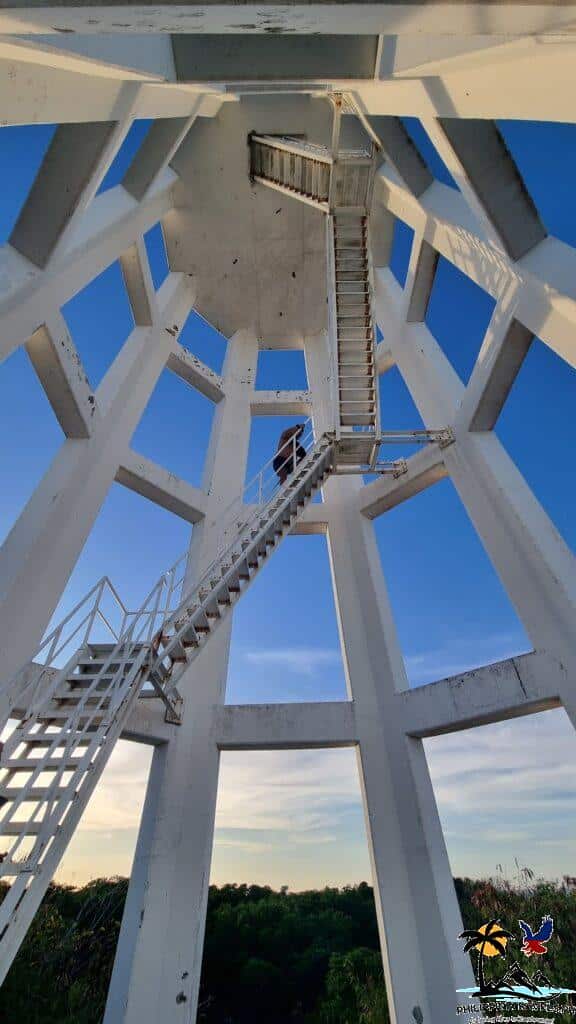
Standing close to the island’s shore is a 36-meter lighthouse that cuts through the seamless blue of the sky.
If you’re brave enough to climb its narrow, slightly shaking stairs (it’s safe, I promise!) you’ll be treated to views like this…

…and this…
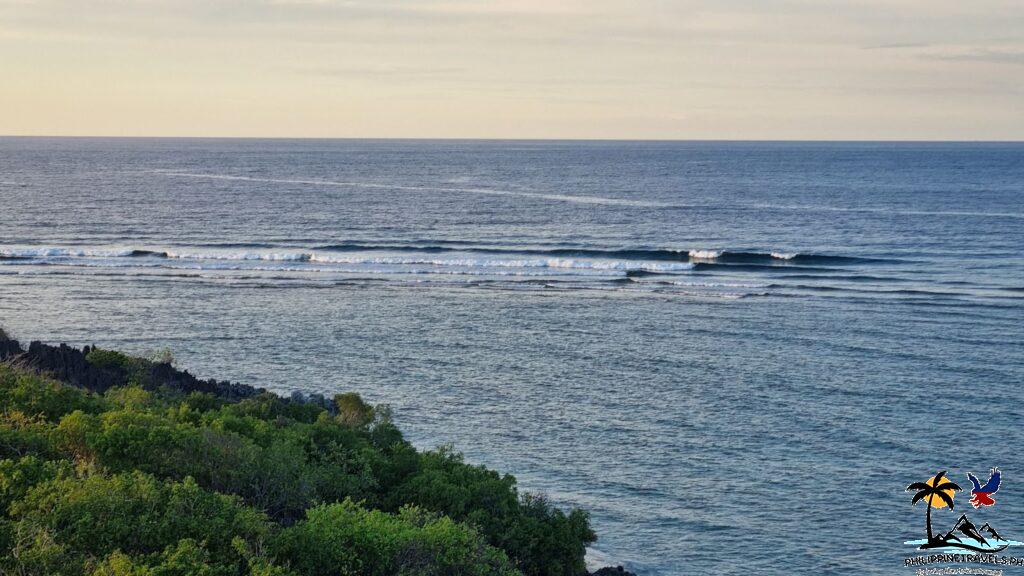
…and this…
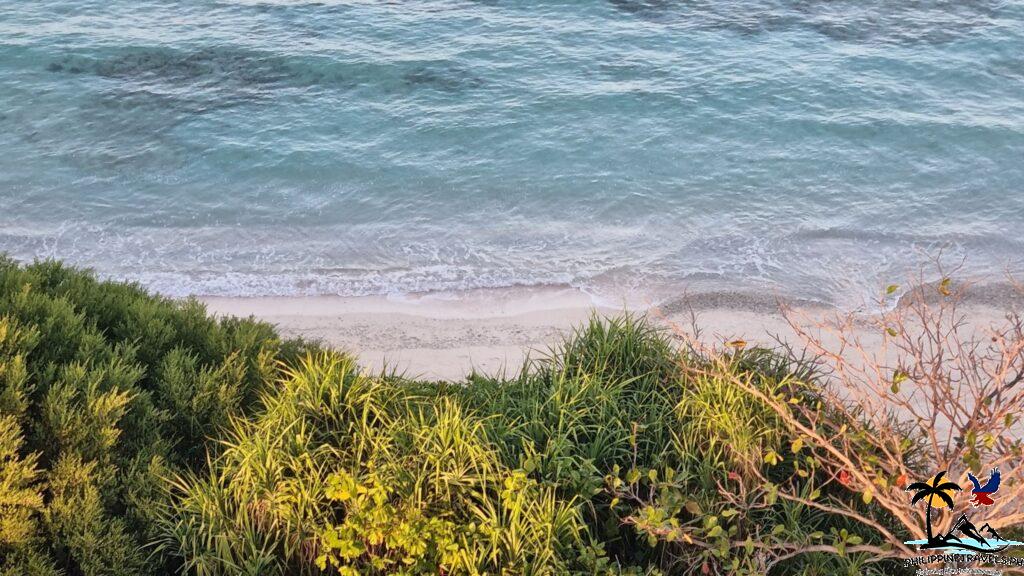
The lighthouse provides a 360 view of the island – you’ll be surprised at how small it is, standing up at that height!
4. Visit the Mangrove Forest and Lagoon
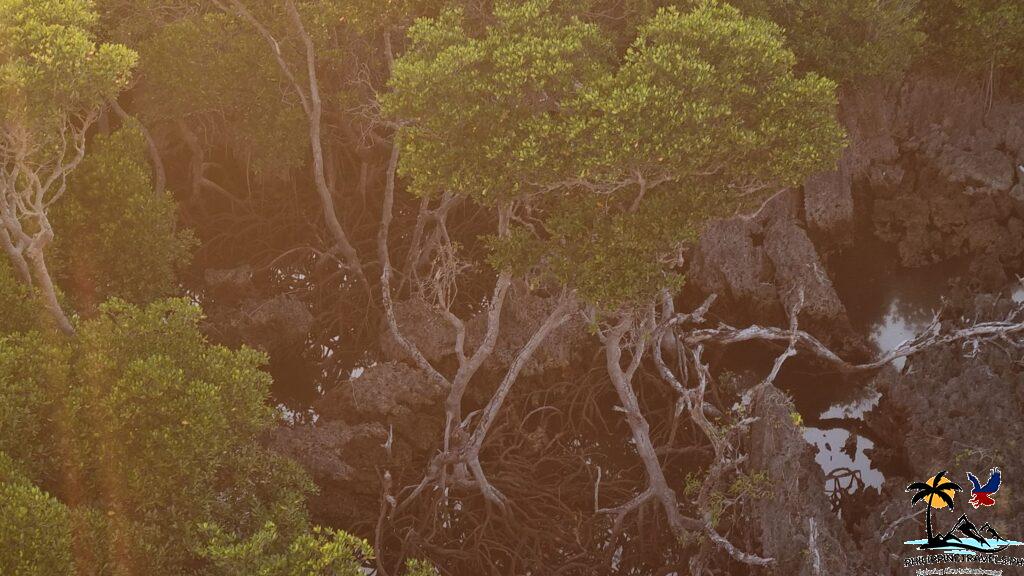
Apo Island has a short mangrove forest trail that ends up in a silent, inky olive-green lagoon.
You walk over connected bridges that allow you to get up close to the twisted, gnarly roots of the mangroves.
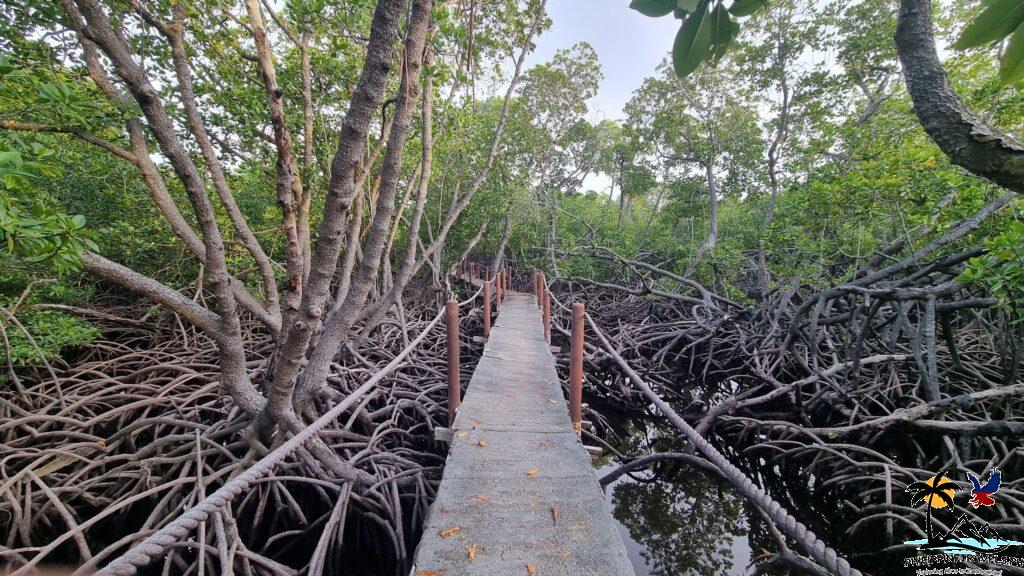
The bridges end up in a little lookout…
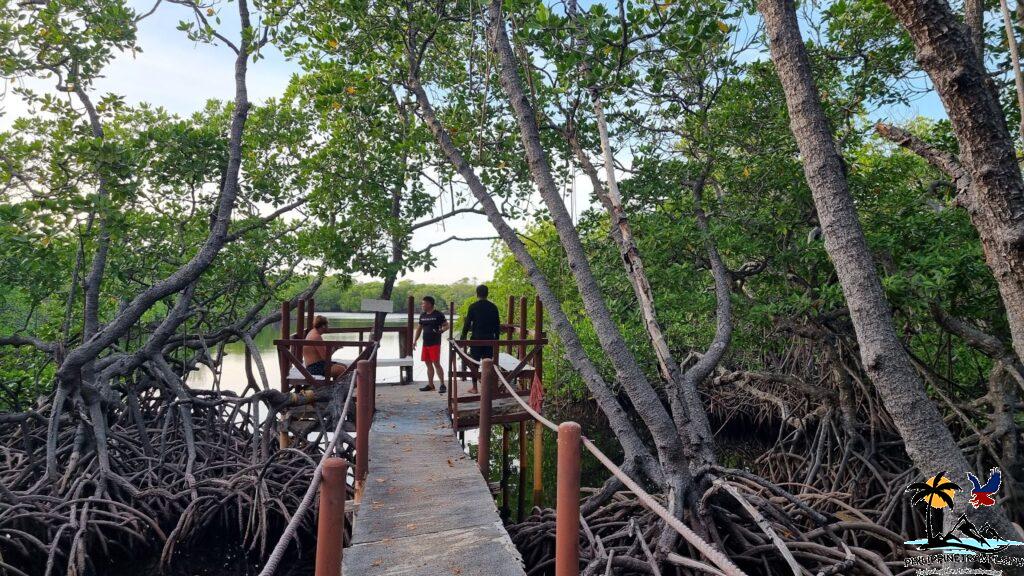
…from which you can gaze at the mirror-like waters of the lagoon.
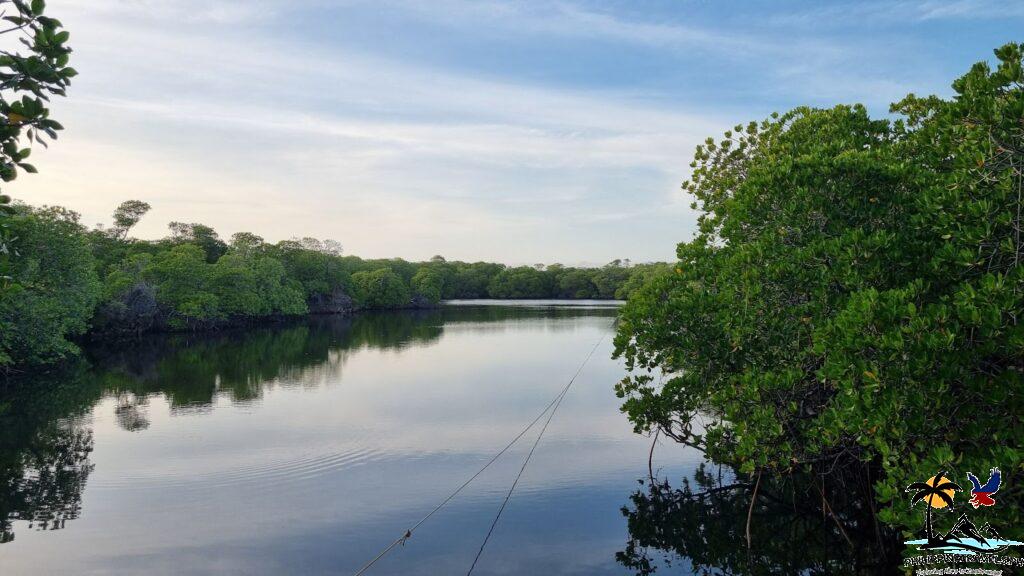
You can even go rafting – there’s supposed to be a raft that takes you to the other side, but it was under repair when we visited.
Who knows? It might be fixed by the time you get there.
5. Watch the Sunset
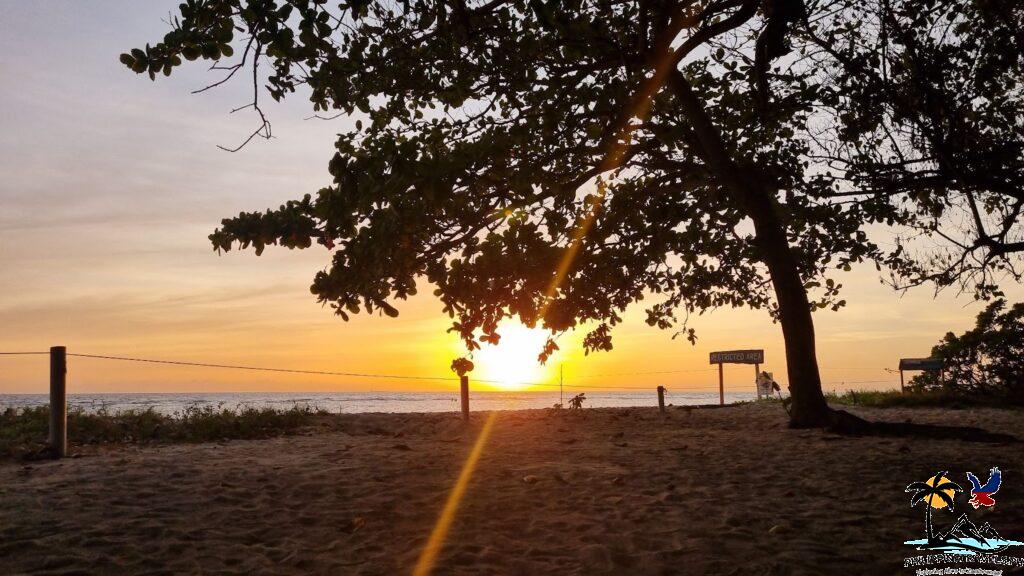
Grab a cup of coffee or hot chocolate, sit on the sand, and get ready to see a spectacular sunset show.
If you stay longer, you’ll see a storm of stars come out, along with some fireflies.
6. Play in the Sand
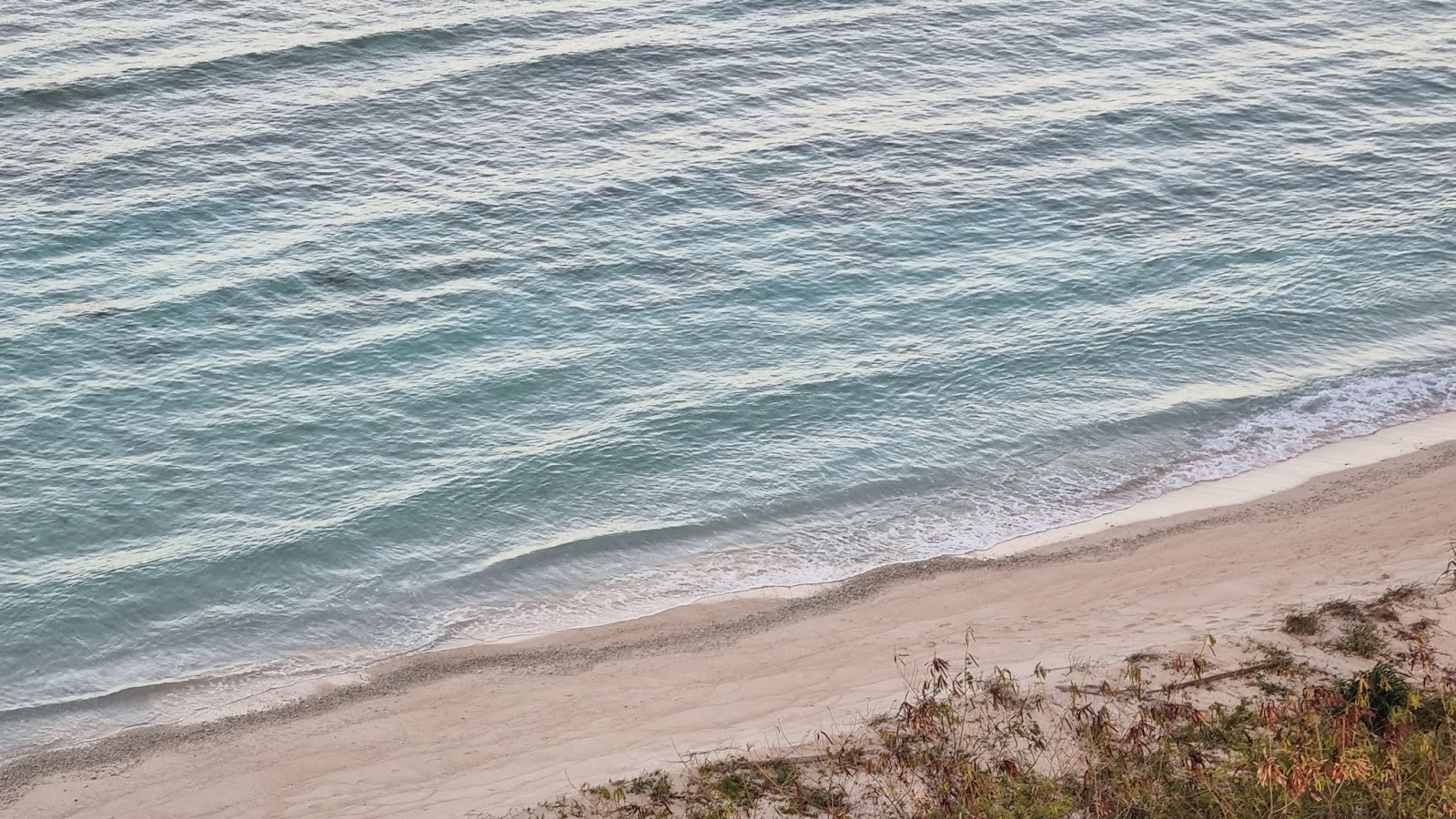
I’ve been to a lot of white-sand beaches like Boracay.
But nothing compares to Apo Reef’s soft, thick, creamy sand.
If you don’t love getting into the water, just digging your feet into the sand and watching your footprints get washed away by the tide is more than worth it.
Who Can Enjoy Apo Reef?
“I’m not a scuba or freediver,” you might say. “Maybe Apo Reef isn’t for me?”
My answer: Apo Reef is for everyone!
While it does have deeper dive spots, you can always enjoy the lush, lively coral gardens around Apo Island.
The depth there slopes from around 3-7 meters before plunging into the real deep, so you can snorkel in the shallows and enjoy the beautiful sea world from the surface.
What to Bring to Apo Reef (A Checklist)
Like I said, Apo Reef is an uninhabited, off-the-beaten-path location.
It’s not some touristic island with sari-sari stores (mini convenience stores) lining the coast (I’m talking about you, Balicasag).
So if you find yourself on the island and suddenly need paracetamol for a headache…ooops!
You’ll have to wait until you get back to Sablayan.
I remember us wanting Coke to go with our Crispy Pata (deep-fried pork leg) and fried chicken lunch, and the organizer saying, “Oh, no, that’s impossible. There are no boats coming in today or tomorrow.”
So, you get the point.
It’s an isolated island, so make sure you bring everything you need for your stay.
Here’s a list the organizers sent us:
- 1 gallon of drinking water per head – Your tour organizer should bring enough drinking water for all the guests. But if you have a sensitive stomach, you might want to pack your own. We stayed 3 days and 2 nights on the island, and this was enough for us. However, if you drink more than 2 liters of water a day, consider bringing more.
- Mosquito spray – The mosquitoes on the island were one-of-a-kind! Not itchy, but intense verging on painful.
- Personal medicine – For headache, stomachache, dehydration, and anything else you usually take to alleviate pain or discomfort.
- Flashlight – It can get dark on the island, and your phone is going to die around the second day, so an old-fashioned battery-powered flashlight helps you get to the bathroom at night.
- Tent – There are no rooms on the island. If you’re staying a couple of nights, the only place to stay is in tents. So bring yours, along with a sleeping bag for the colder nights. (If you don’t want to bring your own tent, you can ask your organizer if you can rent one. I did, and it cost PHP400 ($6.50) per head per night.)
- Jacket. Nights can get chilly or rainy, so make sure you take along your most comfortable jacket.
- Swimwear or a wetsuit. Obviously.
- Reef-safe sunblock. If you’re going to do a lot of diving, pack along a tube of reef-safe sunblock. The sun can get scorching and intense, and you don’t want to go home with angry, red, peeling skin. Remember – reef friendly. You don’t want your lovely sea friends getting poisoned with toxic chemicals.
- A portable fan. The weather out on the island is erratic and unpredictable. On the first night, a cold breeze was blowing from the sea, and I had to huddle deep into my sleeping bag. However, on the second night, it was hot and airless. Some of us were sweating. Others decided to sleep out of their tents on the swings and benches around the beach. So if you bring a small, handheld portable fan, you’ll be prepared for anything!
- Snacks. Tours serve 3 meals a day, but there will always be those random midnight cravings you can satisfy by bringing your own bag of chips, chocolate, or whatever you love to snack on.
Closing Thoughts (And a Suggestion)
So, you’re planning to visit Apo Reef.
What I can say: Go right ahead!
This was the most beautiful place I’ve ever dived in, and you will not regret it.
One thing I would have done differently, though.
Instead of compressing all the travels into one day, I’d take things slower.
Travel to Batangas from Manila, then maybe spend the night there.
Travel to Abra de Ilog and Sablayan the next day, then spend a night in Sablayan town. (There are rooms there, not fancy, but OK.)
Join the tour I booked as they gather in Sablayan port on the morning they take the boat to Apo Reef.
Something like this:
| Day 1 | Bus to Batangas, Sleep in Batangas |
| Day 2 | Ferry to Abra de Ilog, Van or Taxi to Sablayan, Sleep in Sablayan |
| Day 3 | Meet Tour in Sablayan Port |
Another option is to meet the tour in Abra de Ilog (it’s a bit hard to get to Sablayan port, so if you don’t like negotiating, this might be the option for you).
Remember, though.
Tours are carefully planned, so make sure you let your tour organizer know you’re meeting them in Sablayan Port instead of Batangas.
Other than that, I would not change a single thing about the trip!
It was amazing, spectacular, once-in-a-lifetime.
I will remember it forever.
P.S. The MAIN reason people don’t visit Apo Reef is that it’s difficult to plan it into your Philippines itinerary. That’s why I decided to create the Philippines Trip Planner, so I can help you find the most reasonable way to travel here. So check it out here!
Thank you Nikki..Nice Blog.
I appreciate your approach.